Three vendors will quote you for the same problem this month. One will call its product a chatbot, one an AI assistant, one an AI agent. All three demos will look similar. The prices will not be.
The words are not interchangeable, and the difference is not marketing. It comes down to one question: how much does the system decide on its own?
The short answer
| Rule-based chatbotAI assistantAI agent | |||
| How it decides | Follows a decision tree you drew | Understands the request, then answers | Understands the request, then acts — choosing which steps to take |
| Knows your business? | Only what you typed into it | Yes, from documents or a database you connect | Yes, and it can look things up mid-conversation |
| Can it take action? | Only pre-wired actions | Rarely — it mostly answers | Yes: books, updates, escalates, creates records |
| Handles the unexpected | No — falls to "I didn't understand" | Usually, within its knowledge | Usually, and can change approach mid-task |
| Predictable? | Completely | Mostly | Least — the trade-off for flexibility |
| Use it when | The process never varies | People ask questions | Something needs doing, not just answering |
The one-line test: if the system can only tell you things, it is a chatbot or an assistant. If it can change something — a calendar, a CRM record, an order — it is an agent.
That distinction matters commercially, because agents are the ones that can be wrong in expensive ways. A chatbot that misunderstands wastes a customer's time. An agent that misunderstands books the wrong appointment.
Why the confusion exists
It is not an accident of language. Three things drive it.
The categories genuinely overlap. A modern product is often all three at once: a scripted flow for the top five questions, a language model for everything else, and tool access for booking. Asking "is this a chatbot or an agent?" can be the wrong question—the useful question is "Which mode handles which request.
"Agent" already meant something else. In customer service, an agent is a person. So "AI agent" gets used loosely to mean "the AI thing that replaces what an agent did," regardless of architecture.
Naming follows fashion. "Chatbot" carries the memory of a decade of bad ones. Vendors moved to "assistant" and then to "agent" faster than their products changed. Some 2026 "AI agents" are 2019 decision trees with a language model bolted to the fallback branch.
Rule-based chatbots: predictable, and that is the point
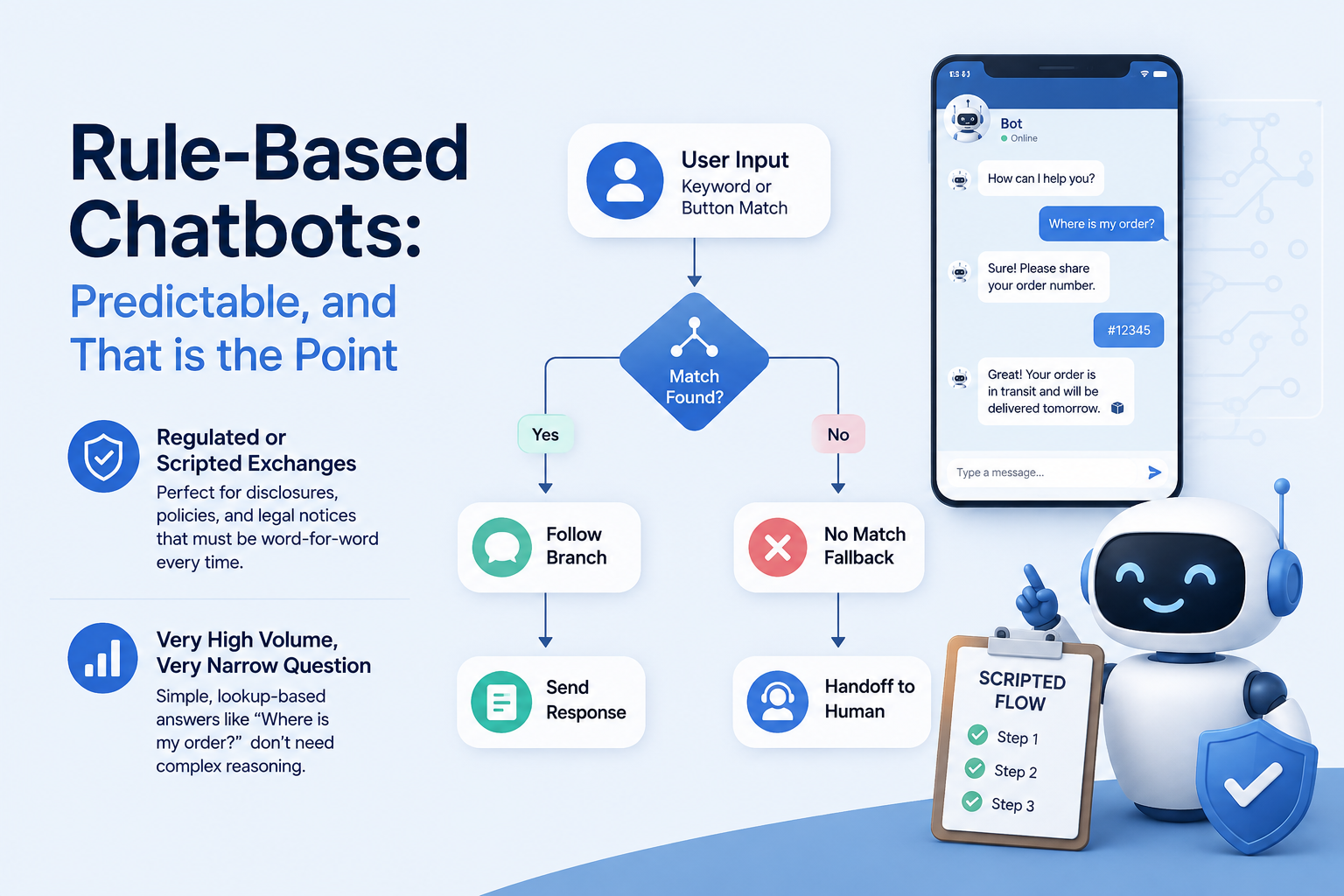
A rule-based chatbot follows a flow somebody drew. Keyword or button matches a branch; branch produces a reply.
Where it genuinely wins:
- Regulated or scripted exchanges. If the reply must be word-for-word every time — a disclosure, a policy, a legal notice — a decision tree is a feature, not a limitation. A language model that paraphrases is a liability here.
- Very high volume, very narrow question. "Where is my order?" answered by an order-status lookup does not need reasoning.
- Zero tolerance for surprise. You can read a decision tree and know everything it will ever say.
Where it fails: the moment someone phrases a question in a way you did not anticipate. Real customers do this constantly. The failure is visible and irritating: "Sorry, I didn't understand that. Please choose from the options below."
Realistic example. A courier's tracking bot handles "where's my parcel" perfectly. A customer types "the driver left it at the wrong gate and now the guard says he doesn't have it" — that has no branch, and never will.
AI assistants: they understand, then they answer
An AI assistant uses a large language model to interpret what was actually meant, then answers from knowledge you have given it.
The technique behind most business assistants is retrieval-augmented generation (RAG): the system searches your documents for relevant passages, then writes an answer grounded in what it found. That grounding is what separates a useful business assistant from a chatbot that invents plausible nonsense.
Where it wins:
- Questions with real answers in your material. Policies, specifications, hours, pricing, "does this fit that?"
- Wide surface, shallow action. Hundreds of possible questions, no follow-up task.
- Deflection before escalation. Resolve the answerable; hand over the rest.
Where it fails: anything requiring an action. An assistant can tell a customer that Tuesday at 3pm looks free. It cannot book Tuesday at 3pm.
Realistic example. A building-supplies company connects its price list and spec sheets. The assistant answers "What's the coverage of a 20 kg bag?" and "Do you deliver to Gujranwala?" accurately all night. It cannot place the order.
A caution worth stating plainly: an assistant is only as truthful as its grounding. Connected to a stale document, it will answer confidently and wrongly — which is worse than not answering, because the customer believes it. Whatever you deploy, know what it is reading and how you update it.
AI agents: they decide what to do
An AI agent adds two things: tools and the discretion to choose among them.
A tool is any capability you expose — check a calendar, create a CRM record, look up an order, send an email, escalate to a human. The agent decides which to use, in what order, and when it is finished. In current systems this is usually implemented as function calling: the model is told which tools exist and what arguments they take, and it responds with a call rather than prose.
That is the whole leap. Not better language — agency.
A concrete sequence. A property enquiry arrives on WhatsApp at 10pm: "Is the Gulberg apartment still available? Could I see it this week?"
- Searches the listing database → still available
- Answers the question, with the price
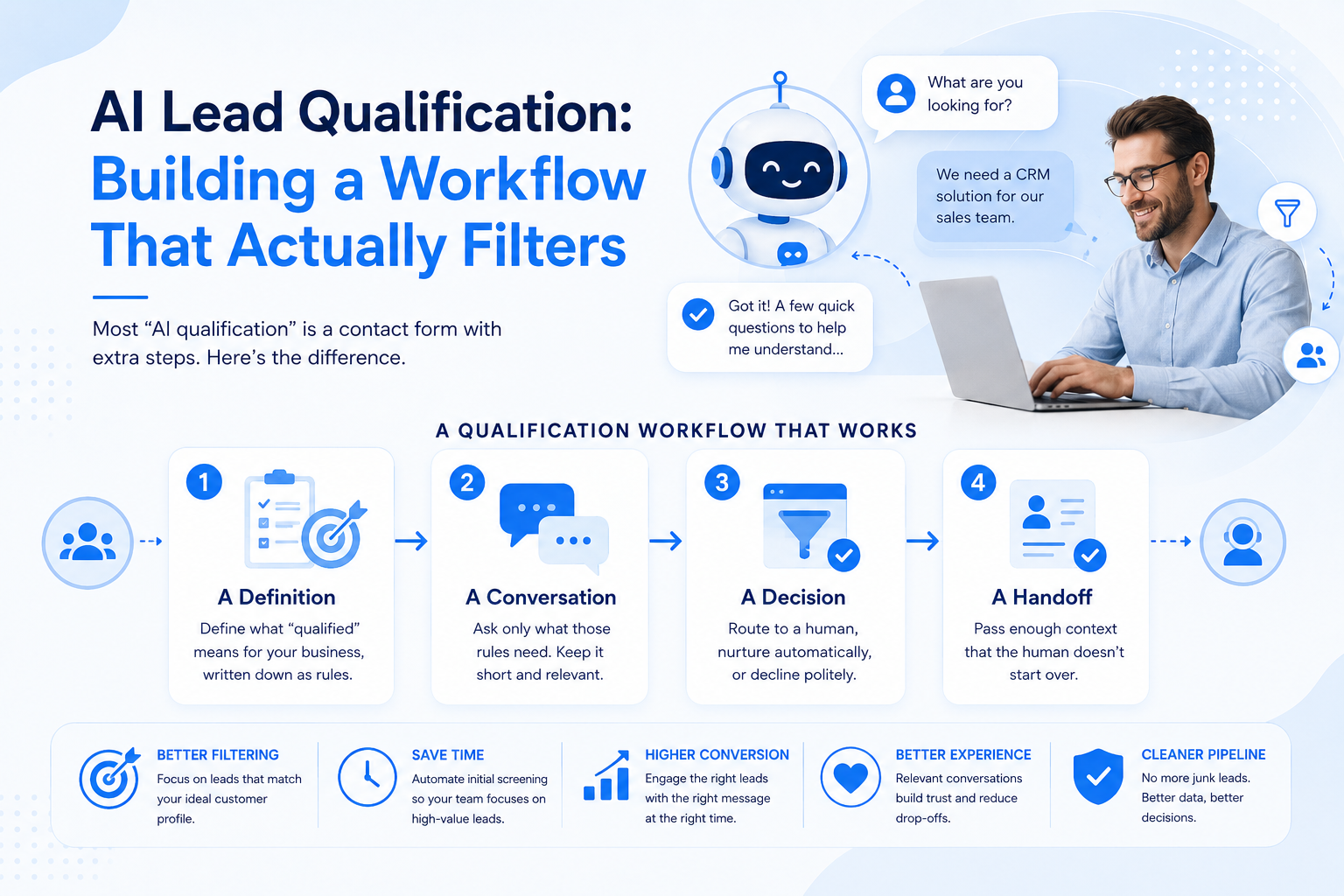
- Asks two qualifying questions — budget, and buying or renting
- Checks the agent's calendar → offers Thursday 4pm or Saturday 11am
- Books the chosen slot
- Creates a CRM lead with the transcript and qualification answers attached
- Notifies the human agent
A chatbot could do step 1 with a rigid script. An assistant could do steps 1–2. Only an agent does 3–7, and only an agent adapts when the customer says "actually, do you have anything cheaper in DHA?" halfway through.
Where it wins: the enquiry has to become something — a booking, a lead, a ticket, an order.
Where it fails, and this is the part vendors skip:
- It can take the wrong action. The failure mode is no longer a bad sentence, it is a wrong booking. McKinsey's 2026 research on AI trust puts it precisely: organisations must now contend with systems doing the wrong thing — taking unintended actions, misusing tools, or operating outside their guardrails — not merely saying the wrong thing (McKinsey, State of AI trust in 2026).
- It is harder to test. A decision tree has finite paths. An agent with six tools has a combinatorial space you cannot enumerate.
- It needs permissions, and permissions are risk. An agent that can write to your CRM can write badly to your CRM.
Which is why the adoption numbers are less triumphant than the marketing. McKinsey found 88% of organisations use AI in at least one function, but only around 23% are scaling an agentic system — and no more than 10% are scaling agents in any single business function (McKinsey, The State of AI, November 2025). Experimenting is easy. Trusting one in production is not.
Two more terms you will meet
AI workflow automation
A fixed sequence with AI at one step: when an email arrives → classify it → route it → notify someone. The AI classifies; the workflow decides. Deterministic, testable, and often the right answer when the process genuinely does not vary. Not an agent — the agency lives in your flowchart.
Agentic workflow
An agent operating inside constraints you set: it may use these four tools, must get approval before refunding over a threshold, must escalate if the customer says "complaint". The current mainstream direction of travel, because it keeps most of the flexibility while bounding the blast radius.
If you are buying in 2026 and the vendor cannot tell you where their guardrails sit, that is the question to keep asking.
Which one do you actually need?
Work down this list and stop at the first "yes".
- Must the wording be identical every time, for compliance? → Rule-based chatbot. Do not use a language model.
- Do people mostly ask questions your documents already answer? → AI assistant.
- Does something need to happen — a booking, a lead, a ticket, an order? → AI agent.
- Is the process fixed, with one judgement call in the middle? → Workflow automation with an AI step.
- All of the above, on different requests? → One agent with a scripted path for the fixed cases. This is the common real answer.
Sanity checks before you sign anything
- "Show me it being wrong." Ask for a failure, not a happy path. How does it behave on an ambiguous request? A vendor who has never shown you a failure has not tested one.
- "What can it change?" Get the list of writes: calendar, CRM, orders, refunds. If the answer is vague, the permissions are too broad.
- "How does it escalate?" Every system needs a competent exit to a human. Ask what triggers it and what the human sees.
- "What is it reading, and who updates it?" Grounding decays. Someone must own it.
- "What happens when it doesn't know?" "I don't know, let me get someone" is a correct answer. Confident invention is not.
What this looks like in practice
By channel, because the right choice shifts:
| ChannelUsually the right fitWhy | ||
| Website chat | Assistant → agent | Starts as questions; converts when it can book or capture |
| Agent | Conversations are long-running and transactional | |
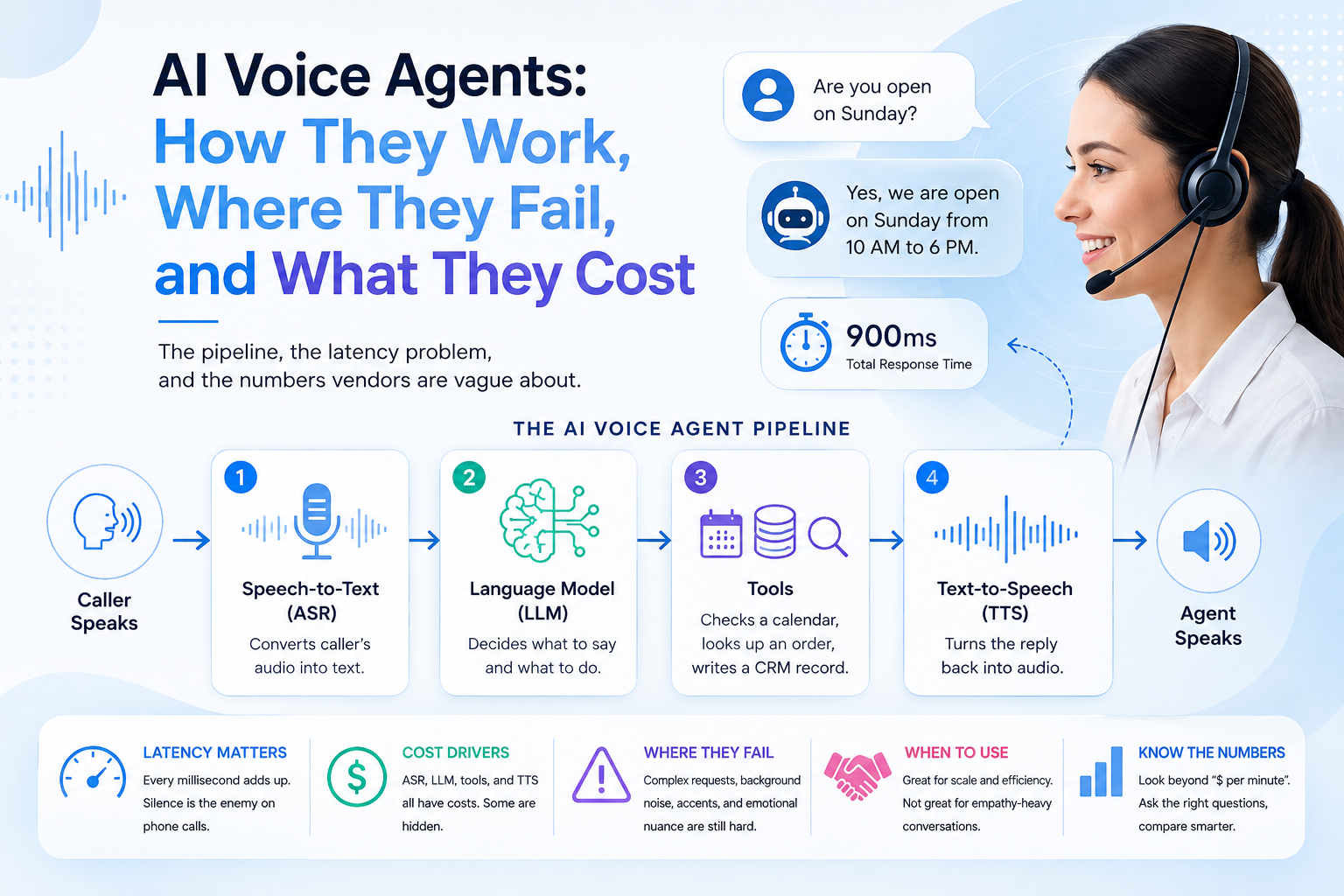
| Phone | Agent | A caller asking to book will not accept "visit our website" |
| Instagram / Facebook DMs | Assistant, escalating | Mostly pre-sales questions; volume is spiky |
| Workflow automation | Not real-time; classify and route beats conversing |
Serve AI runs a single agent across all of these, with the same knowledge and the same CRM behind it — so a customer who starts on WhatsApp and later calls does not have to repeat themselves.
Frequently asked questions
Is an AI agent just a chatbot with a language model?
No. Adding a language model to a chatbot gets you an assistant — better understanding, better answers. An agent adds tools and the discretion to use them. The difference is whether it can change something, not how well it writes.
Can one system be all three?
Yes, and most good ones are. A scripted path for fixed cases, an assistant for questions, agent behaviour when something needs doing. Ask a vendor which mode handles which request — the answer tells you how carefully they have thought about it.
Are AI agents reliable enough for customer-facing work in 2026?
For bounded tasks with guardrails and a human escalation path, many businesses are running them in production — Salesforce reports AI-agent adoption in customer service rose from 39% to 66% year over year across 3,075 service professionals (State of Service, 7th edition). For open-ended authority over money or sensitive records, the honest answer is: constrain it, log everything, and review.
What is the biggest mistake buyers make?
Buying an agent for a problem an assistant solves. Agents cost more, take longer to deploy, and carry action risk. If nobody needs anything done, you are paying for capability you will not use.
Do I need to understand RAG or function calling to buy this?
No, but knowing the terms lets you ask the two questions that matter: what is it reading (grounding), and what can it do (tools). Vendors who answer both clearly are usually the ones who built it properly.
Will an AI agent replace my support team?
Not in any deployment worth having. The pattern that works is agents handling volume and routine, humans handling judgement, complaints and the unusual — with a clean handoff. Gartner's own forecast of high autonomous resolution rates is explicitly about common issues, not all of them.
The takeaway
Chatbots follow rules. Assistants understand and answer. Agents understand, decide, and act. Everything else in a vendor conversation is a variation on those three, and the label on the box tells you less than the answer to "what can it change?".
Get the category right before you compare prices. Most disappointing AI deployments are not bad products — they are the wrong category bought for the job.
See how it works in practice — Serve AI runs one agent across phone, web chat, WhatsApp, Instagram and Facebook, answering from your own data and writing leads into your CRM. See what it costs or talk to us about your workflow.