AI customer support is the use of an AI agent to answer customer questions automatically — on chat, phone, WhatsApp, social messaging and email — using a business's own information, and to hand conversations to a person when they need one.
That one-sentence definition hides most of what matters. Whether an AI support deployment helps or quietly damages your customer relationships comes down to three things: what the AI is allowed to answer from, what it is allowed to do, and what happens when it should stop. This guide covers all three, without the vendor gloss.
The short answer
| Question | Short answer |
|---|---|
| What does it handle well? | High-volume questions with a clear, documented answer: hours, prices, stock, order status, bookings, policies |
| What does it handle badly? | Complaints needing discretion, refunds needing judgement, anything whose answer is not written down anywhere |
| Is it the same as a chatbot? | No. Scripted chatbots follow menus; AI agents read free-form questions and can take actions |
| Does it replace a support team? | It replaces repetitive work. The team moves to the conversations that need a person |
| What decides whether it works? | The quality of the information behind it, and a tested route to a human |
How AI customer support actually works
Strip away the branding and almost every AI support system is the same four-part loop.
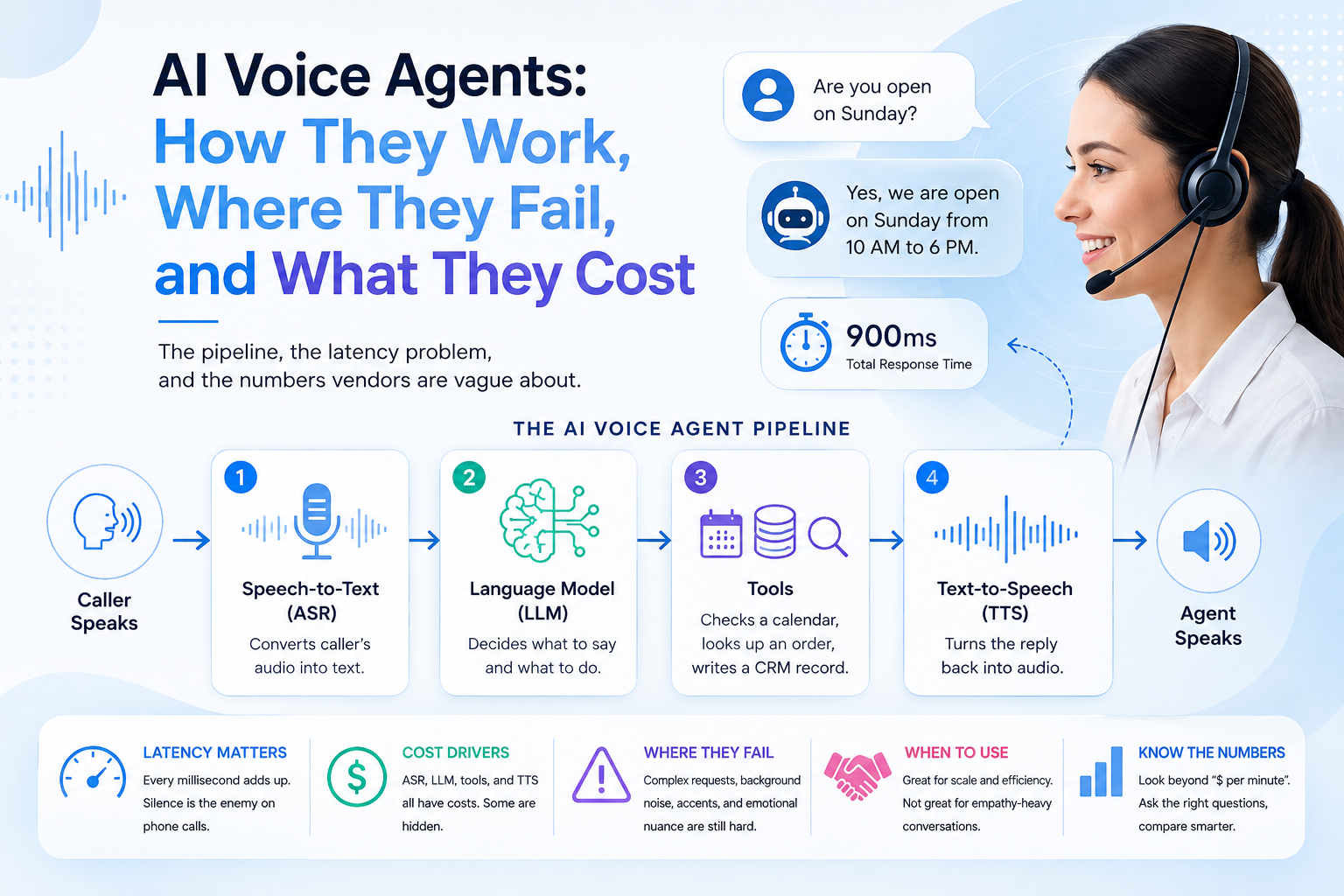
- A message arrives. Typed on a website, sent on WhatsApp, or spoken on a phone call — in which case speech recognition turns it into text first.
- The system finds relevant information. It searches the knowledge you connected — web pages, documents, a product database, a CRM — for passages that relate to the question. This step is usually called retrieval.
- A language model writes the reply. It is given the question, the retrieved information and your instructions, and composes an answer. A well-built system tells the model to answer only from what was retrieved and to say it does not know otherwise.
- The system decides what happens next. Send the answer. Or call a tool — look up an order, check availability, open a ticket. Or hand the conversation to a person.
Step 2 is where most quality problems start, and it is the least glamorous part. A model given an out-of-date price list will quote out-of-date prices, fluently and confidently. Step 4 is where most trust problems start: a system that cannot recognise when to stop will keep a frustrated customer in a loop.
AI customer support vs traditional support
It helps to be concrete about what changes, and what does not.
| Traditional support | AI-first support | |
|---|---|---|
| First response | When someone is free — minutes to a day | Seconds, at any hour |
| Channels | Each one staffed separately, or not at all | One agent answers on all of them |
| Consistency | Depends on who answers | Same source, same answer — right or wrong |
| Hard cases | Handled by people | Still handled by people |
| Main failure mode | Slow replies, missed messages | Confident wrong answers, no way out |
The last row is the one to plan around. AI swaps a slow failure for a fast one. That is a good trade only if you have made the fast failure rare and recoverable.
What the research actually says
The numbers are moving quickly, and the headline figures deserve context.
- Salesforce's survey of 3,075 service professionals found AI-agent adoption in customer service rose from 39% to 66% in a year (State of Service, 7th edition).
- The KPI organisations most often report improving after deploying AI service agents is customer satisfaction — ahead of productivity and handle time (Salesforce). The usual pitch is cost; the measured benefit is often speed and availability.
- Companies that unify their channel data are 1.4 times more likely to report a very successful AI implementation (same report) — which is the practical argument for one inbox rather than a separate bot per channel.
- Gartner predicts agentic AI will autonomously resolve 80% of common customer service issues by 2029 (Gartner). Note the word common, and note the date.
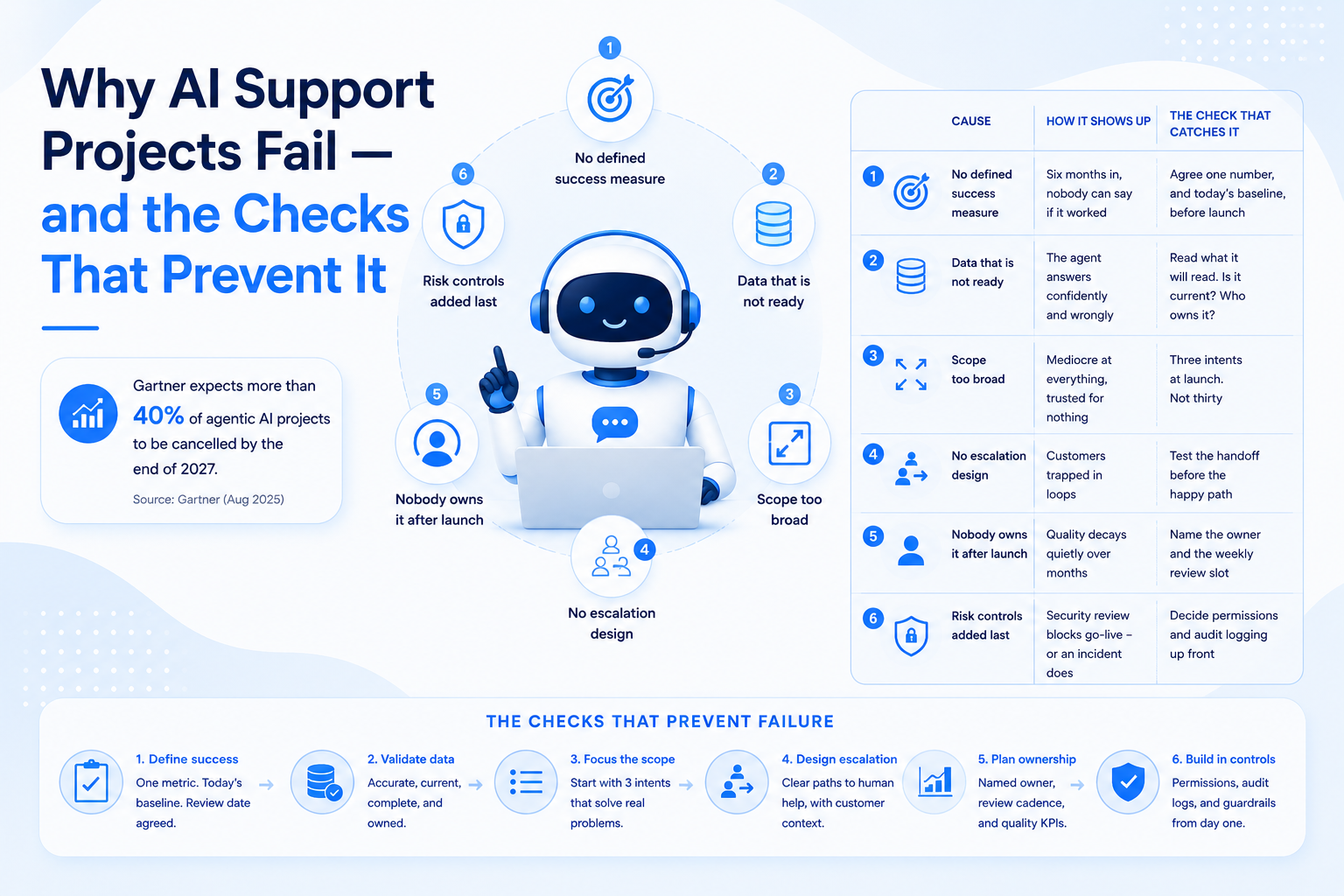
The counterweight belongs in the same list: Gartner also expects more than 40% of agentic AI projects to be cancelled by the end of 2027. We looked at why in why AI support projects fail. The short version is that the failures are organisational — vague goals, stale data, broad scope — rather than technical.
Chatbot, assistant or agent?
You will see all three words used for the same product. The useful distinction is how much the system decides on its own.
- A scripted chatbot matches input to pre-written responses. Predictable, limited, frustrating off-script.
- An AI assistant understands free-form questions and answers from your content, but does not act.
- An AI agent can also take steps: call your order system, book a slot, qualify a lead, open a ticket, decide to involve a person.
For customer support, the jump from assistant to agent is what turns "here is our returns policy" into "I have started your return — here is the label". It also adds work: every action needs a connection to one of your systems, and every connection needs testing. Our taxonomy of chatbots, assistants and agents goes deeper.
What to automate first
Do not start with everything. Start with three request types that are:
- High volume — enough that automating them visibly frees your team;
- Low risk — a wrong answer is annoying, not costly;
- Well documented — the correct answer already exists in writing and someone owns keeping it current.
For most businesses those are some combination of opening hours and location, prices and availability, order or booking status, and a handful of policy questions. Get those genuinely right, measure, then widen.
The handoff is the product
Every demo shows the happy path. Customers remember the other one. Before launch, test these deliberately:
- A customer asks for a person. How many messages until they get one?
- The AI does not know the answer. Does it say so, or improvise?
- A customer is angry. Does the system notice, and route accordingly?
- A person takes over. Do they see the whole conversation, or ask the customer to repeat it?
- The person is done. Can the AI pick the conversation back up?
If any answer is unsatisfactory, fix it before worrying about how clever the answers are.
Frequently asked questions
Is AI customer support the same as AI customer service?
In practice, yes. Both describe using AI to answer customers and resolve routine requests. Some organisations use "service" for the broader relationship and "support" for problem-solving, but vendors and buyers use the terms interchangeably.
Will AI customer support replace my team?
It replaces a share of their repetitive work. The conversations that remain are, on average, harder and more valuable — which is a reason to keep experienced people, not fewer of them.
How accurate is it?
As accurate as the information behind it and the instructions around it. A system restricted to answering from current, well-maintained sources, and told to admit when it does not know, is far more reliable than one allowed to fall back on general knowledge.
Can small businesses use AI customer support?
Increasingly, yes — and they often benefit most, because they have the fewest people to cover evenings, weekends and multiple channels. Look for tools that work from your existing website and documents without a development project.
How do I measure whether it is working?
Pick one number before launch and record today's value: the share of enquiries resolved without a person, median first-response time, or after-hours enquiries answered. Review it weekly for the first month.
The takeaway
AI customer support works when it is narrow, grounded and easy to escape: a small set of well-documented questions, answered only from information someone keeps current, with a tested route to a person. Built that way, it gives customers a faster answer at any hour and gives your team back the time they spend repeating themselves.
Want to see it on your own content? serveAI's AI customer support answers on calls, web chat, WhatsApp, Instagram and Facebook from the information you connect, and hands conversations to your team in one shared inbox. You can start free.