Most systems sold as "AI lead qualification" do not qualify anything. They collect a few extra fields and hand your team the same undifferentiated pile, now with more typing involved.
Qualification is a decision, not a questionnaire. This is a practical framework for designing that decision — what to ask, how to score, when to route to a human, and the mistakes that make the whole thing pointless.
The short answer
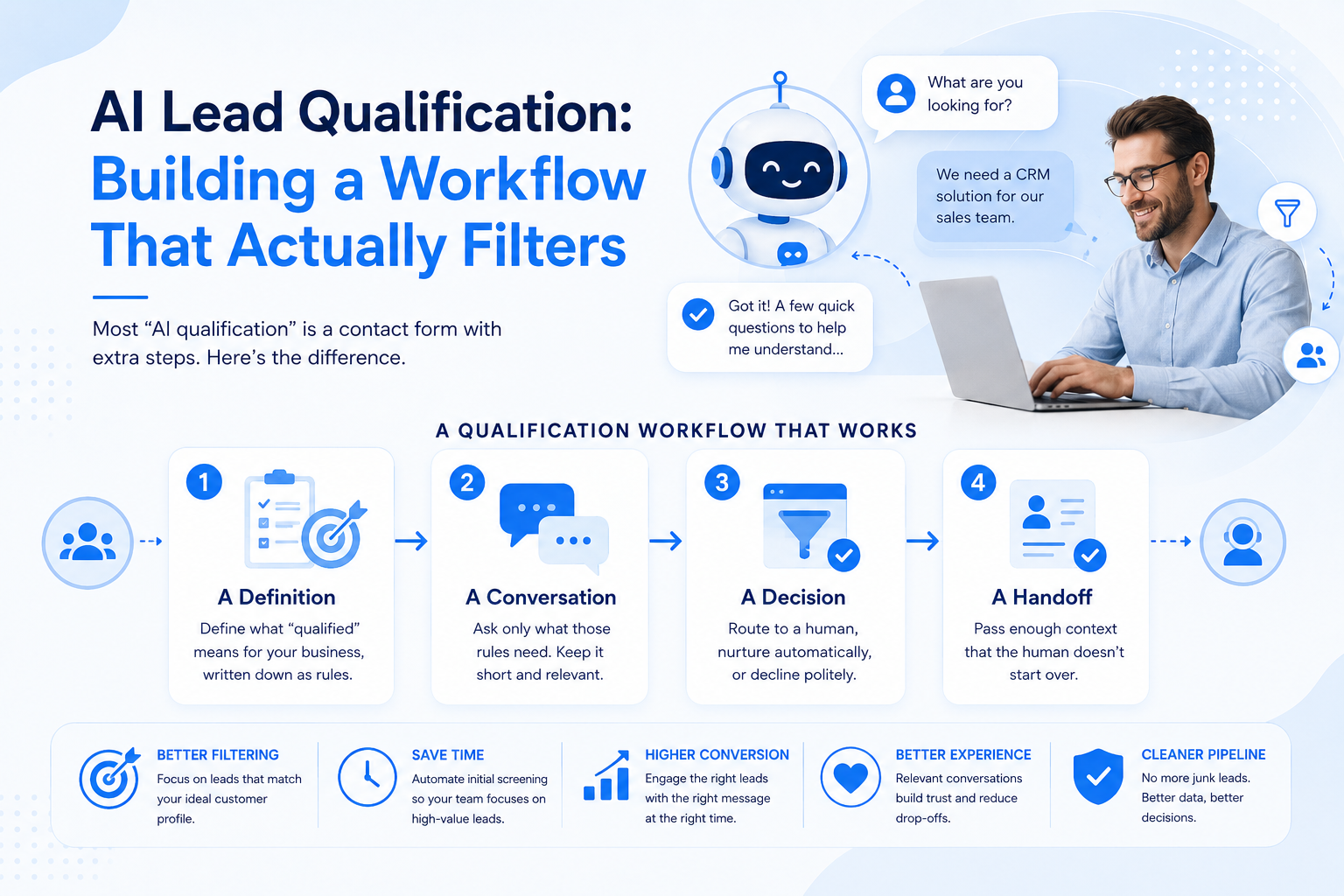
A qualification workflow that works has four parts:
- A definition of what "qualified" means for your business, written down as rules
- A conversation that gathers only what those rules need
- A decision — route to a human, nurture automatically, or decline politely
- A handoff carrying enough context that the human does not start over
Miss the first and you have a chatbot asking questions nobody uses. Miss the fourth and your team re-qualifies every lead by hand — which is the work you were trying to remove.
Start by writing down what qualified means
This sounds obvious and is skipped constantly. Before automating anything, answer: which enquiries do we want a human to call within the hour, and what is true about them?
| DimensionExample ruleHow you learn it | ||
| Need | Wants a service we actually offer | Ask, or infer from what they described |
| Scale | Budget or volume above our floor | Ask indirectly — a range, not a number |
| Timing | Buying within 90 days | Ask directly; people answer this honestly |
| Fit | In a region or sector we serve | Often inferable without asking |
| Authority | Can decide, or can bring the decider | Ask only in B2B, and gently |
Two disciplines make this list useful. Keep it to three or four dimensions — every extra one costs you completed conversations. And write the disqualifying condition too: knowing who you do not want is what makes a filter a filter.
Design the conversation around the decision
The classic mistake is a form in disguise: five questions in a row, no context, nothing given back. Completion rates collapse — and the people who do finish are not necessarily your best leads, they are the most patient ones.
- Answer before you ask. Someone who asks "do you do X?" gets a real answer first. Then a question. Reciprocity is the whole mechanism.
- Ask in the order the conversation suggests, not in your CRM's field order. An agent can do this; a form cannot.
- Infer rather than interrogate. If the enquiry says "for our clinic in Lahore", you have sector and location. Asking anyway signals nobody read it.
- Stop when you can decide. If the third answer already disqualifies, do not ask the fourth.
- Never ask for something you will not act on. Every unused field is friction you charged the customer for nothing.
Scoring: keep it explainable
Elaborate scoring models are appealing and usually a mistake early on. Nobody trusts a number they cannot interrogate, and a sales team that does not trust the score ignores it.
Start with something a person could compute on paper:
- Hard filters first. Out of area, out of scope, obviously spam — decline politely, do not score.
- Then a small additive score. Three or four signals, each worth a defined amount.
- Then three bands. Hot (human now), warm (automated nurture, human this week), cold (self-serve resources).
Three bands is deliberate. Ten grades of lead create an argument about grading; three create an action for each.
Review the scoring against outcomes after a month. The only test that matters is whether "hot" leads convert better than "warm" ones. If they do not, your rules describe something other than buying intent — and no amount of AI fixes a wrong definition.
The handoff is where most of the value is
A qualified lead delivered badly is barely better than an unqualified one. What the human receives should include:
- The full transcript, not a summary alone — exact wording carries intent
- The answers to the qualifying questions, as structured fields
- Which band and why, in one line a rep can read while dialling
- The channel and time — someone who messaged at 11pm on WhatsApp expects a reply there, not a phone call at 9am
- Anything the customer explicitly asked for, flagged
This is where an agent architecture earns its keep over a form: it can write all of that into the CRM as it goes, so the record exists the moment the conversation ends.
It is also where a unified data layer matters more than the model does. Salesforce found that organisations which unify their channel data are 1.4× more likely to report a very successful AI implementation (State of Service, 7th edition). If a WhatsApp enquiry and a web-chat enquiry from the same person land as two unrelated records, no qualification logic makes that coherent.
Mistakes that make qualification useless
| MistakeWhat happensFix | ||
| Qualifying before answering | People abandon; you lose the good ones too | Answer the question they came with first |
| Too many questions | Completion collapses | Three or four, tied to real rules |
| Scoring nobody understands | Sales ignores the score | Explainable rules, three bands |
| No disqualification path | Everything routes to a human; nothing is filtered | Define and enforce "not for us" |
| Losing the transcript | The human re-qualifies from scratch | Attach it to the CRM record |
| Never reviewing outcomes | Rules drift from reality | Compare bands to conversions monthly |
A worked example
An interior fit-out company gets enquiries across WhatsApp, Instagram and their website. Most are homeowners wanting a single room; the profitable work is commercial fit-outs above a certain size.
Their rules: commercial premises, project starting within three months, within two cities. Everything else is nurture or decline.
- Enquiry arrives: "Do you do office interiors?"
- Agent answers properly — yes, with two sentences on typical scope
- "Is this for a commercial space or a home?" → commercial
- "Roughly when are you hoping to start?" → next month
- "Which city?" → in range
- All three match → books a site visit into the calendar, creates the lead as hot, notifies the commercial team with the transcript attached
A homeowner asking the same opening question gets an equally polite answer, a link to residential partners, and no site visit. Nobody's time is wasted, and the enquiry is not simply ignored — which matters, because that homeowner talks to people.
Frequently asked questions
Does AI qualification replace SDRs?
It replaces the first-pass filtering, not the selling. What it reliably removes is the hour a day spent on enquiries that were never going to buy, and the delay before a good lead gets a reply.
Will customers resent being screened by a bot?
They resent being ignored far more. An instant, useful reply ending in "let me get the right person" reads as competent. What reads badly is being interrogated before getting any value.
How many questions is too many?
If you cannot justify each one against a rule you actually apply, it is too many. Three or four, asked conversationally, is the practical ceiling before completion drops noticeably.
What about leads that disqualify but might buy later?
Do not discard them. A "not now" is a nurture record with a date on it. The mistake is treating disqualified as deleted.
Can this work for inbound phone calls too?
Yes — the logic is identical, only the channel changes. The difference is that on a call you must decide faster and cannot show links, so the qualifying set usually needs to be shorter still.
The takeaway
Qualification is a decision you have already made, written down and applied consistently. The AI is what applies it at 11pm on a Sunday across four channels without getting bored. If you have not written the rules down, automating them will only make the mess arrive faster.
See it end to end — Serve AI qualifies enquiries across phone, chat and WhatsApp, then writes a scored lead with the full transcript into your CRM. See what it costs or talk through your rules with us.